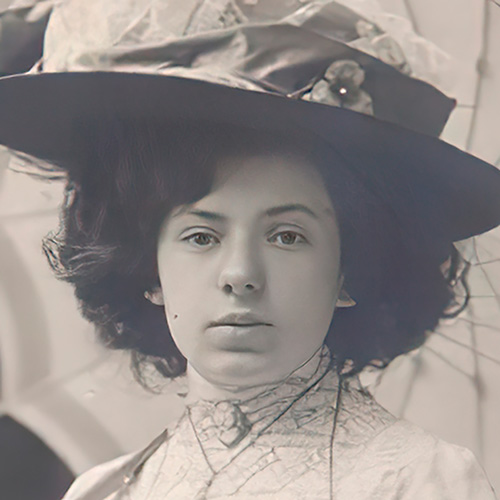
Vera Inber was born in Odessa, a city which gave Soviet literature many eminent writers. Her mother was a teacher and her father the director of a publishing firm. The future author spent her childhood in the sheltered atmosphere of a well‑to‑do home, little aware of the “storms” her country was then passing through.
Her first collection of verse — Sad Wine — appeared in Paris in 1914. This, like the two succeeding volumes, consisted of imitative verse of little literary value.
"In October 1917, from the window of my room in Moscow, I was able to watch the corner of our street where fighting was going on between the White Guards (cadets) and the Red Guards. On one occasion a small bullet (white or red — who knows?) smashed through the double window panes and landed on my dressing table.
It was a grim reminder of the fact that the coziness of my room was illusory and that the role of an outside observer was out of the question. Events forced me to decide once and for all: How am I to live in the immediate future? What shall I write about? Whom shall I write for? The time of ‘bitter pleasure’ and ‘mortal words’ had come to an end. New themes and new readers had taken their place."
The age was one which inevitably confronted writers with this choice, and thus the Soviet writer and poet Vera Inber was born. Her road to an understanding of her new reader was not an easy one. Nevertheless, in the 1920s and 1930s she wrote excellent short stories, essays and verse, full of human warmth and understanding for the spiritual values treasured by her contemporaries.
During the Great Patriotic War of 1941–1945, Vera Inber remained in besieged Leningrad. She described the Leningrad blockade in a series of short stories entitled Nearly Three Years (Leningrad Diary), in her poem Pulkovo Meridian and in numerous other short stories and verses. Nearly Three Years is a day‑to‑day chronicle of the life of besieged Leningrad as seen by the writer.
Stories about children make up a large part of Vera Inber’s works. They are not stories for children, nor are they light‑hearted stories about children for adults. They are tales of our time, which are sure to leave their mark on young hearts.