Once, in the morning, in the rye barn’s glow,
Where mats are stacked in a golden row,
A bitch gave birth, full of tender care
To seven sweet pups, with their coats so rare.
All seven red, they squirmed and cried,
She licked them clean, stayed by their side.
Till dusk came, she kept them warm,
Her belly shielded them from snowy cold.
But then, when the hens were settling near,
The owner came with his eyes severe.
A sack he brought with his heart like stone,
He took the pups, she was left alone.
Through snowdrifts deep, she ran in haste,
She was hardly able to follow his trace…
For long she stood by deep waters gleam,
Their unfrozen surface rippled, and ruined her dream.
Whilst dragging back, her strength all spent,
She licked her sides, her body bent.
Above the hut, the moonlight rose,
A pup’s frail shape it seemed to pose.
She howled into the blue lit skies,
Her grief reflected in her cries.
The moon then slipped behind the hill,
Its light extinguished, all the world was still.
Sadly, as if in mocking disgrace,
When a stone is tossed for a dog to chase,
Her eyes, like stars, began to flow,
Rolling deep into the icy snow.
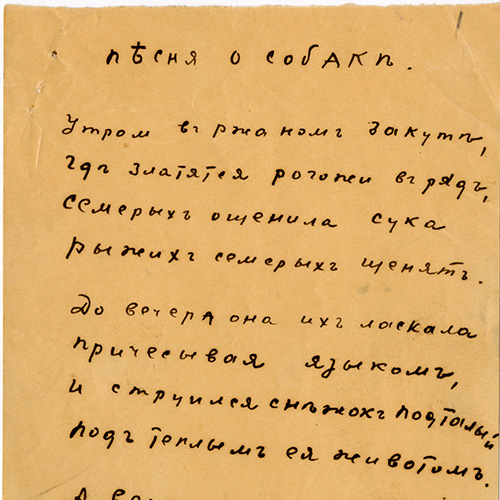
Утром в ржаном закуте,
Где златятся рогожи в ряд,
Семерых ощенила сука,
Рыжих семерых щенят.
До вечера она их ласкала,
Причесывая языком,
И струился снежок подталый
Под теплым ее животом.
А вечером, когда куры
Обсиживают шесток,
Вышел хозяин хмурый,
Семерых всех поклал в мешок.
По сугробам она бежала,
Поспевая за ним бежать…
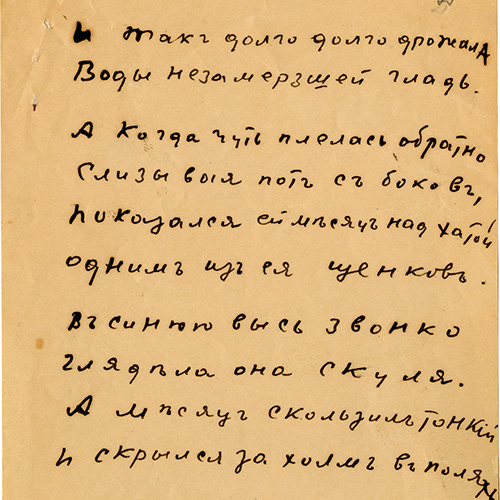
И так долго, долго дрожала
Воды незамерзшей гладь.
А когда чуть плелась обратно,
Слизывая пот с боков,
Показался ей месяц над хатой
Одним из ее щенков.
В синюю высь звонко
Глядела она, скуля,
А месяц скользил тонкий
И скрылся за холм в полях.
И глухо, как от подачки,
Когда бросят ей камень в смех,
Покатились глаза собачьи
Золотыми звездами в снег.